Colorado College
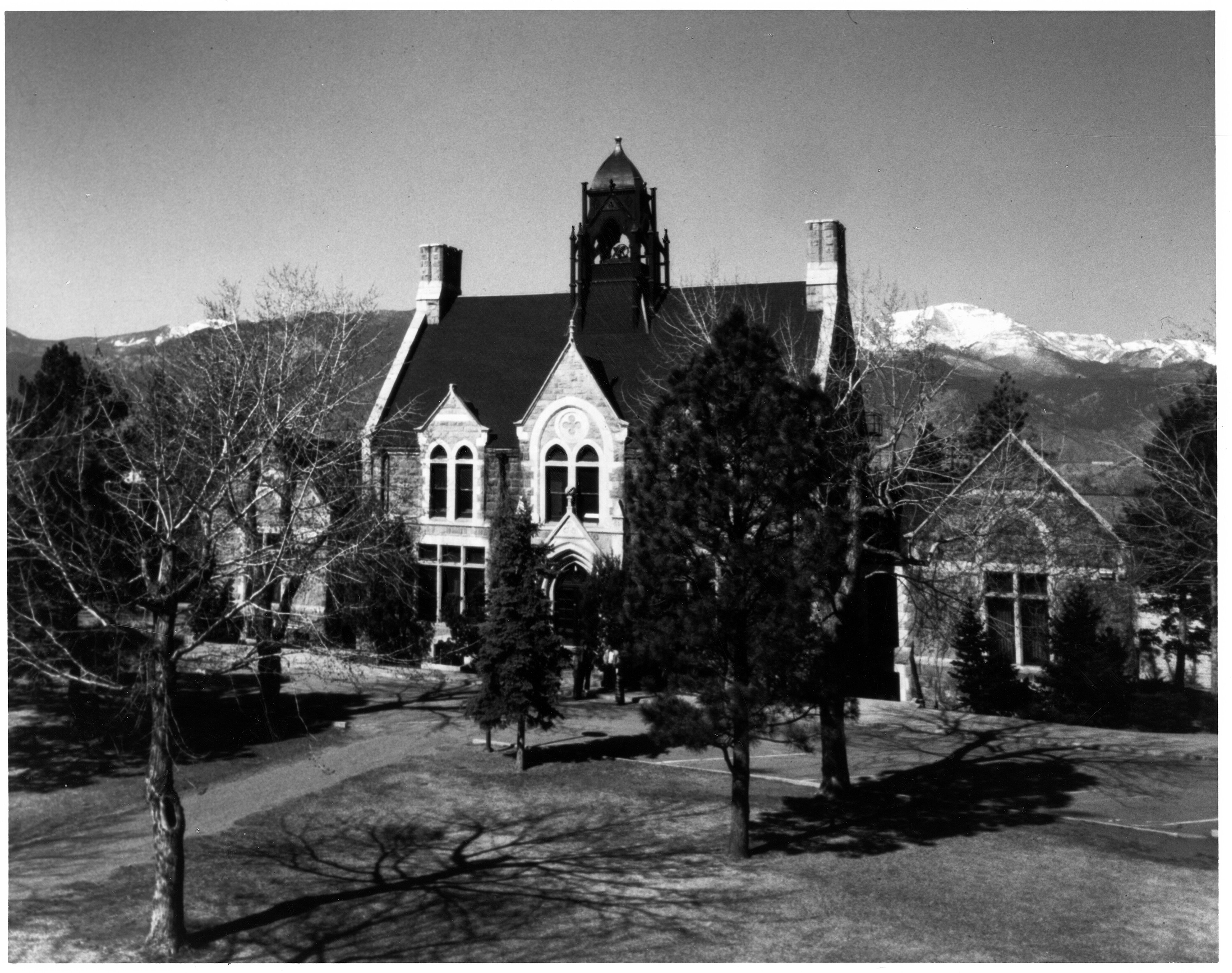
Colorado College is a college in downtown Colorado Springs that was founded in 1874 by Thomas Nelson Haskell. [2]
The college has had a handful of LGBTQ+ groups on campus throughout the years, including but not limited to:
- Gay Liberation Front of Colorado Springs (1969-1973)
- Out and About (1987-1988), before changing name to:
- Bisexual, Gay, and Lesbian Alliance / B-GALA (approx 1991-1997)
- Queer Straight Alliance (QSA) (approx. 1991-2003)
- EQUAL at Colorado College (around 2012-2016 or so)[3]
- Queer People of Color Collective (QPOCC) (2015-?)
- Queer Community Collective (around 2012-2017 or so)[4]
- Queer and Trans Collective (fall 2023-present)
Queer students on campus historically hosted Big Gay Parties, also known as BGPs. The college also hosts annual events such as Drag Ball and Queer Prom. [5]
Events
- Drag Ball (? - ?)
- Big Gay Parties (BGPs)
- SKIRT
Colorado College's Queer History
1970's
Related People
Faculty and Staff
- Katharine Lee Bates
- Paul Kutsche
- Jessy Randall
- Genny Love
- Jane Hilberry
Alumni
- Syd Lapan
- Tamara Bartlett
- Nico Wilkinson
- Han Sayles
- Madaleine Sorkin
- Zivia Berkowitz
- Marcie Wexler
- Katherine A. Pease
Key Dates
- December 11, 1972: Colorado College holds Same-Sex Lifestyles Symposium featuring national figures like Jack Baker and Dr. Mark Friedman. The symposium was in response to the growing unrest between the student body, president Worner, and the Gay Liberation Front of Colorado Springs when Worner vetoed the student government's decision to charter the Gay Liberation Front as a campus group. #key-date
- September, 1973: Colorado College launches its first Women's Studies class, developed by one of the few women professors at the time and the teaching collective with Colorado Springs Women's Health Service Clinic. #key-date
- November 14, 1987 - The Colorado College Board of Trustees approved the following statement to their college catalog and administrative handbooks, making the school the first in Colorado to adopt such a policy, according to a school official at the time: "The policy of Colorado College is not to discriminate on the basis of race, color, age, religion, national origin, sexual orientation, or handicap." #key-date
- 2013 - Colorado College finds itself at the center of a national debate after it uses the word "queer" on an online job application when applicant John Kichi filed a complaint with Colorado Attorney General John Suthers. The story gains national attention and sparks a nationwide debate around the term "queer." #key-date
References
Colorado College (1982). PPLD Digital Collections, accessed 18/08/2026, https://digitalcollections.ppld.org/nodes/view/793297 ↩︎
- “Colorado College,” Wikipedia, February 25, 2026, https://en.wikipedia.org/w/index.php?title=Colorado_College&oldid=1340417206.
This is based on my memory of EQUAL being a group when I started at CC, until I graduated. I am trying to get more clear information on start/end dates ↩︎
Based on first and last dates mentioned on thecatalystnews.com ↩︎ ↩︎ ↩︎ ↩︎ ↩︎
In: 20180410, catalystnewspaper and Features. “Reinventing Prom for the Queer Community.” The Catalyst, 10 Apr. 2018, https://thecatalystnews.com/2018/04/10/reinventing-prom-for-the-queer-community/ ↩︎ ↩︎
“Gayspeak, January 1988.” Pikes Peak Gay Community Center, 11 Jan. 1988, Pikes Peak Library District Special Collections, 0461 Pride Center Box 5, Folder 9. ↩︎ ↩︎ ↩︎
Ziegler, Vicki. “Know Yourself Be Well.” Big Mama Rag 1, no. 5 (1973): 3. Archives of Sexuality and Gender. https://link.gale.com/apps/doc/LLPMSK013889579/AHSI?sid=bookmark-AHSI&pg=4&xid=2ada7b04. ↩︎ ↩︎
Donaciano Martinez. “Interview with Donaciano Martinez Part 2.” Interview by David Duffield. [Denver Public Library], 17 May 2012, https://lgbtqcolorado.cvlcollections.org/files/original/fbafc5a2a303d919a8600c5ace7c05b5.WMA. ↩︎
Shipe, Mallory. “Colorado College Becomes Center of National Debate for Using ‘Queer’ as Gender on Job Application.” The Catalyst, November 15, 2013. https://thecatalystnews.com/2013/11/15/colorado-college-becomes-center-of-national-debate-for-using-queer-as-gender-on-job-application/. ↩︎