Bessie Boyington

a.k.a. Bessie the Girl Hobo, or Red-White-and-Blue-Bessie
Bessie the Girl Hobo is a nickname given to Bessie Boyington, a person around twenty years old who was arrested in Colorado Springs at the Sierra Madre Train Station transed their expression of gender in order to trainhop across the United States.
There are some differing reports about Bessie and her story.
On April 17, 1906, the Rocky Mountain Daily News reported:

[1]
According to the article, Bessie was found in the early morning hours of Friday, April, 13th, 1906. Dressed in man's clothing, she traveled on the rails from Salt Lake City before being intercepted at the Midland yards in Colorado Springs.

She told the railroad man her name was Bessie, but disclosed little else. The police began to investigate her, and Bessie went into hiding, with those she had confided in refusing to disclose her location.

In this article, it was speculated that her reason for traveling back east was to meet with the man she sought to marry, who had recently moved to New York City. [1:1]
The next day, curiosity about Bessie grew, as did efforts to solve the mystery of her identity and story. On April 18, 1906, the Rocky Mountain News reported:

By April 18, the press managed to find Bessie at the home of A. B. Ross and his wife, who tried to protect her from the press. Ross "flew into a rage" when approached for answers, and Bessie tried to sidestep the questions, and said she wasn't seeking help from anyone. She declared she wanted to be left alone to protect her family and the people in Salt Lake City. Upon finding out the press already knew she had connections in SLC, Bessie looked dismayed.
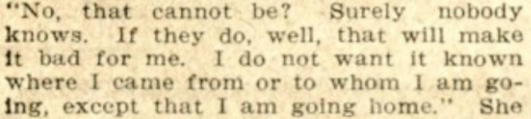
According to the April 18 article, Ross found Bessie looking unwell on Friday morning, as she had not eaten since she left Salt Lake City that Monday. From there, she gotr to Provo, UT before she had to get off that train. She then "tramped" 15 miles before catching another freight and riding it to Rifle.
Police captain Sam Stewart was investigating the mystery, and according to his findings and Bessie's story, Bessie lived in SLC and Idaho towns for four years, after living in Richmond, VA. In Salt Lake City, she was run down by an ox team and was hospitalized for several weeks afterward. As she recovered, she decided she wanted to return home, but "too proud to let her people know of her plight," she decided to do so on her own by dressing as a man.
The police advanced the narrative that she was escaping an unhappy romance. She also avoided talking about Mormonism. "It is a subject the girl avoids, except to explain, with a note of anxiety in her voice, that the Mormons 'treated her well, and I will not talk about them.'"
From there, news of Bessie dies down until a year later on April 30, 1907, when the Salt Lake Telegram reports:

The article states that Bessie returned to Salt Lake City with her new husband, George Penn, who lived in Salt Lake City formerly. It also reports that the night watchman who found Bessie was Thomas Lahey, and that he and his wife helped get her a ticket to New York. Once there, Bessie met George Penn, and it was "love at first sight." The two were married by January, 1907. The article also states that Bessie, now Mrs. Penn, is an orphan who ran away from her relatives in Salt Lake City because they wanted her to marry a man she did not love.
Soon after, on May 1, 1907, the Rocky Mountain News published the following article. [2]
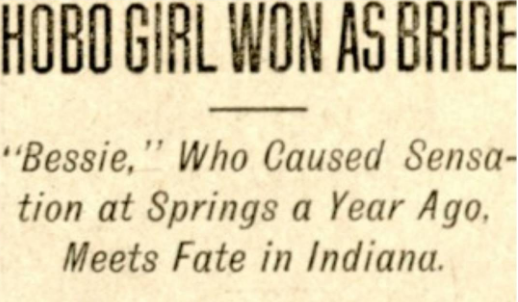
The article states that Bessie stopped through Colorado Springs on her way to Salt Lake City, and that she was now a bride married to Joseph Watson, a discharged soldier. The article states that Bessie left Colorado Springs to go to Kansas City, and from there she went to Br-idgeport, Conn. where she worked in a lace factory, before returning west to a small town in Indiana, where she met Watson.
According to the article, Mrs. A.B. Ross of Colorado City (previously A.B. Ross, unsure which is correct) denies the story that Bessie married a rich man.
"As a matter of fact" said Mrs. Ross, "Bessie and her husband are going to Salt Lake City, her former home, in hope of obtaining employment for him."
This article also reports that, during her stay in Colorado Springs a year prior, Bessie refused to change out of boy's clothing.
It is curious that there could be such discrepancies in reporting from both Colorado Springs and Salt Lake City, cities in which the press may have been able to be in contact with Bessie and her new husband directly.
In 1910, Bessie's story is recounted in the pulp magazine, "The Railroad Man's Magazine," in the article "Rough-Riders of the Rail," in which the author Gilson Willets retells the tale that he says he heard from a Denver and Rio Grande Railway man. According to the retelling, Bessie had been traveling the country for about a year, free-riding on the railroads, and that she didn't mind talking about it. "I feel jim-dandy. I'm in perfect health, and that's more than can be said of girls who have not the courage to turn tramp."
This retelling says that Bessie went on to marry George Penn, and that "in hoboland, on the Colorado railroads" she was known as "Red-White-and-Blue Bessie."
Other Discrepancies
- According to the Durango Semi-Weekly Herald, she was found in a Colorado Midland Boxcar. She was an orphan being raised by relatives whom she disagreed with, so she ran away from home on a boxcar. According to the article, she was turned over to the police, given girl's apparel, and $35 cash and a railroad ticket to Kansas City.[3]
- Durango Semi-Weekly Herald states that she met Joseph in Bridgeport, KY
- Bisbee Daily Review reports that she married George Penn, a wealthy man from New York City
- Spokane Press also runs with the Penn/Lahey version of events[4]
Meanwhile, the Bisbee Daily Review,
There are different reports as to her fate after Colorado Springs. The Rocky Mountain News reported on May 1, 1907 that she went on to meet a man named Joseph Watson in Indiana and married him. [5] The Durango Semi-Weekly Herald reported a few days later that Bessie met Joseph in Bridgeport, KY, and that she and Joseph both visited Mr. and Mrs. A. B. Ross, the brakeman who founder her on the train and his wife, to whom she was grateful for their kindness.[3:1] Meanwhile, the Bisbee Daily Review reported on May 4, 1907 that she got married to George Penn, a wealthy man from New York City. [6]
Notes
Bessie stayed with A.B. Ross at 310 S Third Street, Colorado City. Trying to gauge approximate location. Looks like 3rd St. may have been near what is now Penrose Event Center.

Questions
-
- Attempts to find Bessie Boyington, Joseph Watson, or George Penn through Ancestry.com has been unsuccessful so far.
Key Dates
- April, 13th, 1906: Bessie the Girl Hobo is discovered at the Sierra Madre train station, dressed in mens' clothing. Her story sparks a national media frenzy. #key-date
References
Rocky Mountain News. “Girl Dressed as Man Traveling in Box Car.” April 17, 1906. Colorado Historic Newspapers. https://www.coloradohistoricnewspapers.org/?a=d&d=RMD19060417-01.2.3. ↩︎ ↩︎
The Rocky Mountain News. “Hobo Girl Won as Bride.” May 1, 1907. Colorado Historic Newspapers Collection. https://www.coloradohistoricnewspapers.org/?a=d&d=RMD19070501-01.2.186. ↩︎
Durango Semi-Weekly Herald. “La Plata Valuations Are High.” May 6, 1907. Colorado Historic Newspapers Collection. https://www.coloradohistoricnewspapers.org/?a=d&d=DSH19070506-01.2.24. ↩︎ ↩︎
Spokane Press (Spokane, WA). “Hobo Girl Returns as Rich Man’s Wife.” June 25, 1907. https://access-newspaperarchive-com.ppld.idm.oclc.org/us/washington/spokane/spokane-press/1907/06-25/page-1. ↩︎
The Rocky Mountain News. “CRIPPLE CREEK.” May 1, 1907. Colorado Historic Newspapers Collection. https://www.coloradohistoricnewspapers.org/?a=d&d=RMD19070501-01.2.186. ↩︎
Bisbee Daily Review Newspaper (Bisbee, Arizona). “Girl Tramp Weds Man of Her Choice.” May 4, 1907. https://access-newspaperarchive-com.ppld.idm.oclc.org/us/arizona/bisbee/bisbee-daily-review/1907/05-04/page-1. ↩︎