Gay Liberation Front of Colorado Springs
Formation: 1969
Founders: Malachi Truman Harris, Gene Shinn, Patrick Tracey, Donaciano Martinez
Type: Advocacy
Purpose: To combat heterosexism and fight for the rights of the gay community.
Closed: Early 1973
Related Organzations: Gay Sisters Alliance of Colorado Springs
History
The organization was started in 1969 by Malachi Truman Harris, Gene Shinn, Patrick Tracey, and Donaciano Martinez.[2]
"Do you think gays are revolting? You bet your sweet ass we are."
In 1969, Donaciano Martinez went to visit his friend Gail Whittington in San Francisco. Gail had recently been fired from his job for being gay, which lit a fire in him. Gail had founded the Committee for Homosexual Freedom. During his visit, Donaciano watched as Gail organized, garnering support for his organization along the streets of San Francisco.
When Donaciano returned to Colorado Springs, he told some of his gay friends in the peace movement about the growing movement he witnessed in San Francisco. [3]
Three months later, in June, 1969, the Stonewall Riots broke out. It felt like things were changing, from coast to coast. This helped tip the scales in Colorado Springs. [3:1]
There were three other people, Malachi Truman Harris, Gene Shinn, and Patrick Tracey, who were particularly interested in making a difference for gays and lesbians in Colorado Springs. They would go on to found the Gay Liberation Front of Colorado Springs. [3:2]
The founding of the Gay Liberation Front was controversial, even among the anti-war and anti-poverty activists that the founding members had been working alongside previously. The name itself was even a potential source of controversy among the largely conservative gay population of Colorado Springs, who might take offense to the word "gay" being in the name. [3:3]
While the local gay male community's reception of the group was icy, the lesbians of Colorado Springs encouraged the group to continue. A group of feminists formed the Gay Sisters Alliance of Colorado Springs, a parallel group for women. [3:4]
The two groups would start convening every week to every other week in either Truman's, Gene Shinn, or Patrick Tracey's apartments, and before long, the group started growing in numbers. People would talk about topics related to gay life, such as coming out and job loss. The Front started a hotline that people could call for advice or a listening ear soon after. They also established a speaker's bureau, and would go and speak to churches and other interested groups. [3:5]
The Colorado Springs, Boulder, and Fort Collins chapters of the Gay Liberation Front convened in Denver for an anti-war demonstration on November 6, 1971, carrying a large handmade banner that said GAY LIBERATION FRONT down Colfax avenue, chanting. There were about 80 people in the group. [4][3:6]
Oh, when the gays go marching in, Oh, when the gays go marching in, you know I want to be in that number. Oh, when the gays go marching in.
"We are radicals. We're addressing the root of this problem that's keeping gays and lesbians in their place. We're addressing heterosexism. And we're not afraid to stand up to it."
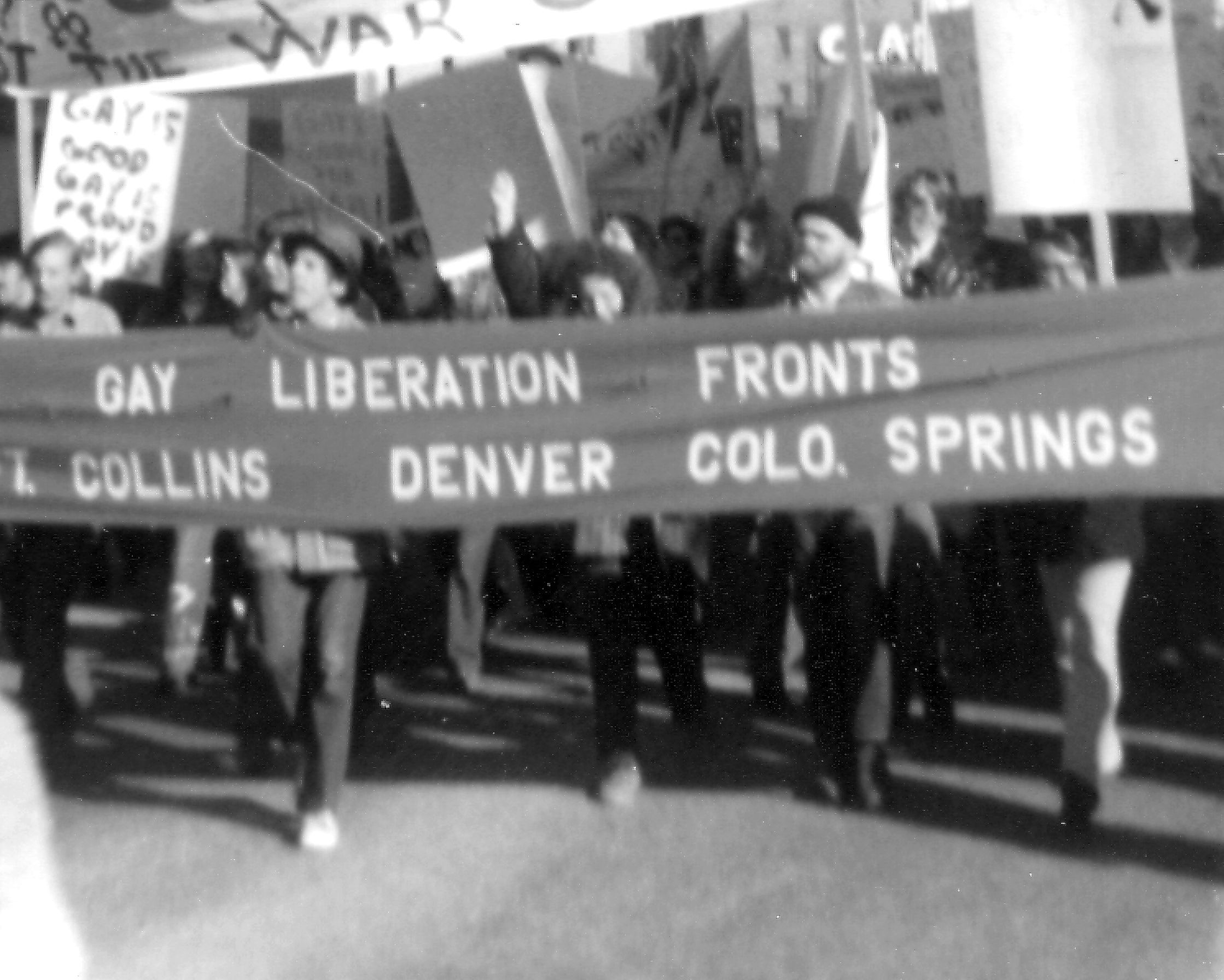
A photo of the Gay Liberation Fronts of Colorado Springs, Denver, and Fort Collins marching in the November 6, 1971 anti-war protest. [5]
"We had knocked down the walls of the underground. We're going to stay out here and we're going to deal with the consequences, whatever they may be."
However, this level of upfront in-your-face activism could be dangerous in Colorado Springs. The group would receive death threats from right-wing organizations like the John Birch Society and the Minutemen, a hate group who had target practice in the hills outside of Colorado Springs. [3:8]
The group had no set structure or roles, as part of the rejection of the broader hegemonic systems. Members would volunteer where they could. The Gay Sisters Alliance of Colorado Springs and the Front would collaborate and volunteer to support one another's efforts. [3:9]
In 1971, the The Hide & Seek opened at its original location at the corner of Cascade and Colorado. Soon after, there were a couple of incidents outside of the bar where gay patrons were targeted by straight men and beaten. The Gay Liberation Front responded with a letter to the owners of the The Hide & Seek, saying that the owners needed to keep straight people out of the bar for the safety of the patrons. In response, Brady and Gehling stated that under the liquor code, they weren't legally allowed to exclude anyone, or even formally call themselves a gay bar. The Front debated picketing, before ultimately letting the issue go, but planning to notify the community that the space behind the The Hide & Seek was not a safe place, and that patrons should leave through the front door. [3:10]
The Gay Liberation Front and Colorado College
In 1972, more gay men from Colorado College started to get involved. Meetings were becoming more and more crowded, with people having to cram into the apartments they'd been meeting in. [3:11]
Ricardo Cruz, the head of MEChA, the Chicano student group at Colorado College, started attending GLF meetings, and had the idea to start a chapter of the group on campus. Upon discussion, Ricardo and the original founders determined it didn't make sense to have two separate groups, and that they should just merge groups instead. Cruz, using his knowledge of the college's chartering process. This would have been an asset to the group, as it would have allowed them to get funding and access to larger meeting spaces. [3:12]
The student government granted the charter, which was then vetoed by Colorado College President Lloyd Worner, who said that he was acting out of concern for the student body, and stated "...the preservation of individual rights does not extend to the sanctioning of aberrant activities, which in addition to being of dubious legality, represent a thread to the institution's continued existence, as a congenial place for learning."[6]
The front started to plan marches and sit-ins to protest Worner's decision. [3:13]
Colorado College's Same-Sex Lifestyles Symposium
The college decided to have a symposium on "Same-Sex Lifestyles" on December 11-13, 1972, to try and facilitate a dialogue and ease the growing tensions between the GLF, the student body, and the college's leadership. The college brought in Jack Baker from Minnesota, Barbara Giddings from Philadelphia, Mark Friedman, and Jerry Gerasch. [3:14]
"...they didn't need to go nationwide to bring activists to put on this two-day symposium to educate the campus. They could have relied on our resource in GLF and the Gay Sisters Alliance. You know, we could have provided that."
The symposium was primarily attended by straight students at the college. Many of the panelists did not want to weigh in on the issue of the GLF's charter, except Jack Baker.
Jack Baker, a nationally known figure in the gay liberation movement, urged the Colorado College student body to put pressure on Worner in response to his decision. He suggested that students set up groups such as "Kill a Commie for Christ", disrupt President Worner's speeches to the Chamber of Commerce, and get the name of college administrators names in the press "and watch them squirm." [6:1]
By 1973, the group was still not charted, but continued to meet regardless. Tyner stated he was ambivalent about getting the charter, but that it would mean that "the college stands up for the rights of minority students."[7]
Worner's decision was unpopular with the student government. The American Civil Liberties Union became involved and threatened to sue the college. President Worner appointed a committee of faculty and students to determine a solution, and the committee ultimately recommended that the college end its discrimination against the gay rights movement.[4:1]
However, the group never did go on to get chartered by the college.
The Gay Liberation Front and Police Brutality
In 1973, the gay and lesbian communities in Colorado Springs and Denver started to encounter increased instances of police oppression. Gay men were frequently being harassed outside of the gay bars in town.
In Spring, 1973, the Front held a protest at Colorado Springs City Hall to address the police harassment that had been going on outside of the local bars. The organization referred to it as the "1973 Witch Hunt." The media refused to cover it, and the more moderate gay men in the community found the move too controversial.
The Gay Liberation Front Dissolves
Tensions grew between the more radical founding members of the Front, and the more conservative new-comers, who wanted the front to be more of a social club. As a result, the more radical members left the group and they decided to form a new group whose purpose would be as a community center in Colorado Springs. This led to the formation of the nonprofit Lambda Services Bureau, though it was initially called Lambda Services to start.
This marked an interesting shift away from more radical actions to counter oppression, such as protests at city hall, to try and use the system to provide necessary services for the local community.
Without the founding members involved, the Gay Liberation Front fizzled soon after.
Community Impacts
While many gay men were initially at odds with the group's more radical messaging, many did eventually come around and started attending meetings. Further, more straight people became aware of the struggles of gay people, thanks to the group's Speakers' Bureau.
While it is difficult to measure the impact quantifiably, Donaciano Martinez cites instances where people who had called into the hotline early on in their coming out process telling him that thanks to those conversations, they were now out and going to the local bars.
"...we were actually doing some really nitty-gritty grassroots work to improve the self image of gay men. Lesbians didn't really need it because they were far advanced than we were they were getting it through the feminist movement and by then by '72-'73 they were way like 20 miles down the road from us."
Were you involved with the Colorado Springs Gay Liberation Front? If so, please consider contributing to the project.
Photos
Do you have photos or print materials related to the Colorado Springs Gay Liberation Front? If so, please consider contributing to the project.
Questions
References
Note: The exact active-start and active-end dates in the metadata are unknown. Just the years. However, an exact date is required for indexing purposes. ↩︎
Focus on the Fabulous : Colorado GLBT Voices. With Internet Archive, Boulder, Colo. : Johnson Books, 2007. Internet Archive, http://archive.org/details/focusonfabulousc0000unse. ↩︎
Donaciano Martinez. “Interview with Donaciano Martinez Part 2.” Interview by David Duffield. [Denver Public Library], 17 May 2012, https://lgbtqcolorado.cvlcollections.org/files/original/fbafc5a2a303d919a8600c5ace7c05b5.WMA. ↩︎ ↩︎ ↩︎ ↩︎ ↩︎ ↩︎ ↩︎ ↩︎ ↩︎ ↩︎ ↩︎ ↩︎ ↩︎ ↩︎ ↩︎
Loevy, Robert D. Colorado College : A Place of Learning, 1874-1999. With Internet Archive, Colorado Springs : The College, 1999. Internet Archive, http://archive.org/details/coloradocollegep00loev. ↩︎ ↩︎
Photographer unknown. GLF Marching in the 1971 Anti-War Protest. Donated by Donaciano Martinez. November 6, 1971. Photograph. ↩︎
Urges harassment of Colorado College president (1972-12-14). PPLD Digital Collections, accessed 04/02/2026, https://digitalcollections.ppld.org/nodes/view/1014097 ↩︎ ↩︎
Gay Liberation Front granted meeting place (1973-02-13). PPLD Digital Collections, accessed 04/02/2026, https://digitalcollections.ppld.org/nodes/view/1014689 ↩︎